TRENTON TALES
Vietnam Vet Finds Honor in His Military Experience
By Julie Hill Lehr
Contributor
Each November, we remember military personnel who served and are serving to protect the United States of America. It’s important for civilians to understand the depth of that service and the personal cost that goes along with it. In this month’s Trenton Tales series feature, we honor former Army Sgt. Gary Dolan.
Early life
Dolan grew up on a farm near Trenton. He struggled in school and though he worked hard, he had trouble excelling.
“I didn’t even know why I was having so much trouble because I couldn’t read,” he explained. “I could do everything else: I just couldn’t read. I think when you have that, you become a problem solver.”
He found out much later as an adult, it was because he was dyslexic. He didn’t have time for after-school activities because he was needed to help on the family farm. He milked cows, took care of livestock, helped with crops and gathered eggs just to name a few of his chores.
Dolan worked hard, but had fun. “Saturdays were a big deal,” he said. “That’s when we came to town.”
They got to have popcorn from the stand, which was near where Trenton Hardware is, and sometimes, they got to go to the movies.
He graduated from Trenton High School in 1961 in a world that was undergoing civil rights discussions, participating in the space race and experiencing great social change. Dolan decided to pursue higher education at Northeast Missouri State University, now Truman State University. He thought he would become a wildlife biologist.
In addition to working on a career, going to college meant that he had less chance of being drafted to go to Vietnam.
Military service
As Dolan continued to pursue his higher education goals, he met Ellen Emery, who also grew up on a farm near Trenton. They got married and continued to go to college.
Even though he was married and in college, Dolan knew that his draft number was likely to come up.
Dolan’s uncle, Jack, who was a World War II sniper, told Dolan and his siblings tales of his experience in the war.
“I didn’t want to sleep in a foxhole like my uncle Jack,” Dolan explained. “I thought if I joined the military, I wouldn’t have to be involved in those battles. I wanted to get in and out and get an easy job.”
He joined the Army in 1966. He took an aptitude test that identified him as someone who would do well as a communication and electronic specialist. He was to become an integrated wide-band communication specialist and was sent to Ft. Monmouth, NJ to learn his job.
After nine months of training, he was sent to Vietnam. He became part of the 1st Signal Brigade, originally called the Strategic Communications Command Signal Brigade. It was located in Southeast Asia, at Long Binh near Saigon. The brigade was charged with helping to create a communications network for the soldiers fighting throughout Vietnam. This network would improve strategic planning and allow knowledge of a particular platoon’s status.
“It was a real sophisticated and an encrypted system,” Dolan said. “We didn’t have much downtime. It was a 24/7 job. We were under a lot of stress.”
As part of his job, Dolan reported to a number of senior officers, letting them know what was happening throughout the communications system. Sometimes it was bad news and the soldiers didn’t particularly want to be the messenger.
“I discovered that it was really important to tell the truth, even if it was grim,” Dolan explained. “They wanted actual truth. One of my big mottoes is that you need to tell the truth.”
Many times, while Dolan was with the signal brigade their building was under fire. “We were under attack every night and every day,” he said. “The whole thing was intense. We had to worry about getting shot and shooting back all the while keeping this encryption communications system up and running.”
Dolan said his entire brigade understood the importance of their job.
“Everyone gave their job 100%. It was more than the call of duty to keep the communication system working,” he said. “I was so busy and excited that I didn’t have time to be scared.”
Dolan said being in Vietnam was a lot to adjust to for a farm boy from Missouri.
“The whole thing was overwhelming,” he said. “You simply had to be there. It was the smell, it was the heat, it was so much. You just had to be there to understand.”
Back in the states
With one year to go in his deployment, Gary was moved to Ft. Hood, in Texas. There, his job was not in great demand the same way it had been in Vietnam. In the states, AT&T was doing most of the work that Dolan and the brigade had done. At Ft. Hood, the soldiers turned their attention to training for a possible conflict with Russia. Dolan said each man had to have a special go bag ready in case they were deployed quickly
He learned a lot in the military, but was grateful when he could go home.
“I was glad to be back home where it was peaceful. I was tired of all the structure so I decided not to go back to college.”
Like many other Vietnam vets, Dolan said he felt wounded when he arrived back in America.
“It broke my heart when I came back, the way people treated us,” he said. “The American people were not supportive of us. When we came home, the American people had no time for us. I’m still a little resentful about that.”
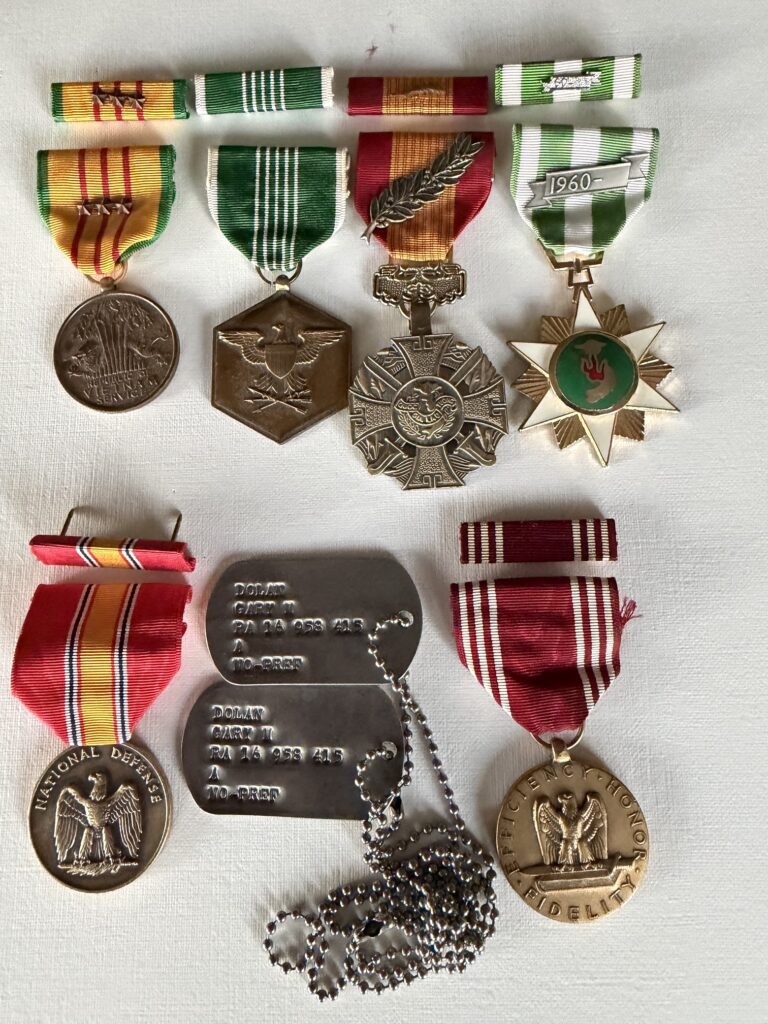
Seen here are a collection of the medals Dolan received during his time in service along with his dog tags.
Though the unpopular war made Dolan feel bad upon his return, he found his military experience valuable.
“I think the military holds our country together and defends our country,” the veteran said. “If somebody tried to overthrow our government, the military are the people who would make sure that doesn’t happen. Most people in the military respect and believe in our constitution.”
During his military career Dolan earned a number of medals including the Army Vietnam service medal, the Army commendation medal, the Republic of Vietnam gallantry cross, the national defense medal and a good conduct medal.
Later in life
Once he was back in Missouri, Dolan decided that farming would be a good career for him. He did various types of farming throughout his adult life.
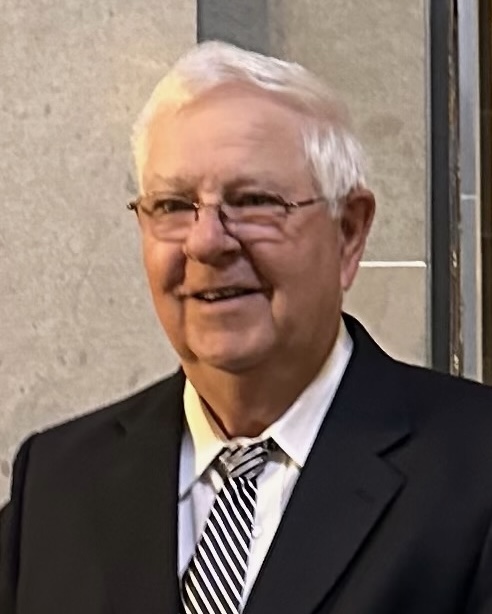
Once he was back in Missouri, Dolan decided that farming would be a good career for him. He did various types of farming throughout his adult life.
Dolan is thankful that he and his wife, Ellen, get to spend lots of time with their family. When he isn’t with his family, Dolan has found a number of activities he feels are worthwhile. A few years ago, Gary heard that the shell of the William Preston Thompson house was going to be demolished. He thought that it was important to try and preserve this piece of Grundy County history.
Gary, Ellen, Ted Drunkenmiller and Tad Trombley came together to try and preserve the William Preston Thompson house, the oldest home in Grundy County. The house was built around 1834 and served as Dr. Thompson’s residence and medical office. They paid $1 for the property.
Working on preserving the house became a passion for the group. They were able to make some progress on the restoration once they secured the property. The Hoover Foundation gave The Friends of the Thompson House a $50,000 grant for initial restoration, and many community members donated more to save the house.
The team worked with local Amish carpenters, who were able to restore a good portion of the house using original home-building methods. It was a lot of work, but a significant amount of progress has been made on the project.
Martha Hoffman Goedert and her husband Jim, have now taken up the mantle and are working on the continuation of the preservation project. Dolan said he was pleased to have been part of restoring history.
Dolan also enjoys woodworking and has made a lot of furniture for his children. He is also a proud member of the Trenton Rotary.
He said that his favorite Trenton event is the Missouri Days Festival each fall.
Dolan explained that no matter what a person undertakes, it is important to pay attention to your values.
“I think some of the best things in life is finding fulfillment in your accomplishments,” he said.